




A batch of leaked battery images has been making the rounds this week, and the headline everyone's repeating is "iPhone 18 gets a major battery upgrade." That's true for one model. For the other, it's barely true at all.
Here's what the numbers actually show, what's confirmed versus what's still a rumor, and why the gap between the Pro and Pro Max matters more than the leak itself.
The Leaked Battery Numbers, Explained
Multiple independent accounts have posted matching images of what's said to be the iPhone 18 Pro and Pro Max battery packs, complete with capacity ratings. Because iPhone battery size varies slightly between the eSIM-only version and the version with a physical SIM tray (the tray takes up internal space that would otherwise go to the battery), the leak breaks down both:
| Model | eSIM Version | Physical SIM Version | vs. iPhone 17 (same version) |
|---|---|---|---|
| iPhone 18 Pro | 4,288 mAh | 4,056 mAh | +0.85% (eSIM) / +1.71% (Physical SIM) |
| iPhone 18 Pro Max | 5,425 mAh | 5,235 mAh | +6.62% (eSIM) / +8.54% (Physical SIM) |
Rumor — based on leaked images, not yet confirmed by Apple.
Worth pointing out: every configuration of the Pro Max now clears 5,000 mAh, which — if it holds — would be the largest battery Apple has ever put in an iPhone. The eSIM vs. physical SIM gap alone is larger than the entire year-over-year increase on the standard Pro, underscoring how much space a SIM tray takes up in a phone this size.

Why the Pro and Pro Max Numbers Look So Different
This is the part that gets lost when people just repeat "iPhone 18 gets a bigger battery." Look at the percentages again: the Pro Max is picking up a real, noticeable increase. The standard Pro is picking up — very little. Under 2%, either version.

That's not really surprising once you think about where the extra space would have to come from. The Pro Max has always had more internal volume to work with than the Pro, simply because it's a bigger phone — more room for the battery to grow without displacing the camera system, the chip, or anything else. The Pro is already tightly packed at its current size, so there's less slack to redirect toward battery capacity without changing something else about the design.
If you're deciding between the two models based on battery life, this leak — if accurate — makes the case for the Pro Max more clearly than it makes for the Pro. We went through the rest of that comparison, including the pricing picture, which you can see in our article “Should You Buy iPhone 17 Now or Wait for iPhone 18? 2026 Price Hike, Rumors, and Buying Guide.”
The Metal Battery Casing — What It Actually Means
The other detail in this leak that's gotten less attention is that the battery pack itself reportedly uses a metal outer casing instead of the pouch-style casing Apple has used before. The reasoning behind it is thermal, not structural — a metal casing dissipates heat more effectively, which matters more than it used to now that phones are running sustained AI processing, gaming, and video work that generates real heat over time. Reportedly, this new casing also lets Apple reroute the internal logic board layout and pack the cells closer together, freeing up space that goes straight into the larger Pro Max capacity above.
It's worth being precise about what this isn't, though: a metal casing is not the same thing as a removable or user-replaceable battery. Separately from any of this, there's an ongoing conversation in the industry about right-to-repair regulations — the EU, for instance, has pushed toward requirements that portable devices use easily replaceable batteries. That's a real regulatory backdrop worth knowing about, but it's a different topic from the one this specific leak describes. Nothing here suggests the iPhone 18 battery is designed to be swapped out by the end user.
One more thing worth flagging as speculation rather than fact: some industry watchers see the metal-can design as groundwork for a future move to silicon-carbon battery cells, which pack more energy into the same physical space than the graphite-based lithium-ion cells every iPhone has used so far. Apple hasn't said anything to confirm this, and the iPhone 18 itself is still expected to ship with a conventional lithium-ion cell — the metal casing is just the kind of structural change that would make a future switch easier, not evidence that the switch is happening now.
A20 Pro's Memory Bandwidth Jump — A Bigger Deal Than It Sounds
Separately from the battery leak, there's a chip-level rumor worth folding into this same conversation: reports out of Japan suggest the A20 Pro may expand its memory bus width from 64-bit to 96-bit — a change Apple hasn't made to its chip architecture in over a decade. There's also talk of the A20 being Apple's first chip built on a 2 nm process, which would be a manufacturing jump on top of the architecture change — that part hasn't been independently confirmed yet, so treat it as a circulating rumor for now.
On paper, that sounds like a spec-sheet number nobody outside a chip engineer would care about. In practice, memory bandwidth is one of the biggest bottlenecks for on-device AI tasks — the kind of processing that Apple Intelligence and Siri increasingly rely on. A wider memory bus means data can move between the chip and memory faster, which shows up less as a benchmark score and more as things like faster Siri responses or smoother on-device model processing. Pair that with a genuinely larger battery on the Pro Max, and the pitch starts to look less like "bigger battery" and more like "the whole system — chip, battery, and software — getting redesigned together" rather than Apple just cramming in more cells the way past generations sometimes did.

Why This Launch Needs to Get Battery Right on Day One
There's a real reason Apple can't afford to treat this as just a spec upgrade: iOS 18 already burned some goodwill on this exact topic. A number of iPhone 16 and older-model owners reported unusually fast battery drain after updating, and turning off things like ProMotion or background app refresh didn't fully fix it for everyone — later updates improved things for some users but not universally, and that inconsistency is what stuck with people.
That leaves the iPhone 18 carrying a bit of extra weight at launch. A bigger battery on paper doesn't mean much if a software update six months later drains it faster than expected — and after the iOS 18 experience, that's exactly the kind of thing longtime users are watching for. Bigger capacity and a more efficient chip are the hardware side of the story; whether Apple's software team keeps power management this tight after the initial release is the part that won't be answerable until people have lived with the phone for a few months.
How Credible Is This Leak?
A few things point to this being a real leak rather than a fabricated one: multiple independent accounts posted matching images and numbers, rather than a single source with everyone else just repeating it. Apple's supply chain — especially this generation — has had a rough few months in terms of information security, following a separate, confirmed data breach at Tata Electronics, one of Apple's assembly partners in India. None of that confirms this specific leak is accurate, but it does fit a pattern of Apple's manufacturing pipeline being less airtight than usual heading into this launch.
Still, worth saying plainly: none of this is officially confirmed. Leaked component images have been wrong before, and the actual numbers Apple ships with won't be locked in until closer to launch.
What About Pricing?
Pricing figures have also started circulating alongside the battery leak. These numbers haven't been independently confirmed by any analyst report we've seen, so treat them as a rumor for now:
| Model | Storage | Rumored Price (USD) |
|---|---|---|
| iPhone 18 Pro | 256 GB | $1,299 |
| iPhone 18 Pro | 512 GB | $1,499 |
| iPhone 18 Pro | 1 TB | $1,699 |
| iPhone 18 Pro Max | 256 GB | $1,399 |
| iPhone 18 Pro Max | 512 GB | $1,599 |
| iPhone 18 Pro Max | 1 TB | $1,799 |
| iPhone 18 Pro Max | 2 TB | $2,199 |
Rumor — not yet confirmed by Apple or independent analyst reporting.
These numbers align with what analysts have said about where price increases are likely to land this cycle — concentrated on the Pro and Pro Max tiers rather than spread evenly across the lineup. We covered that pricing backdrop, along with the broader case for buying now versus waiting, in our article “
Should You Buy iPhone 17 Now or Wait for iPhone 18? 2026 Price Hike, Rumors, and Buying Guide.”
When Does the iPhone 18 Actually Come Out?
Quick recap, since this affects how much weight to put on any of the above: the iPhone 18 Pro and Pro Max are expected to launch in September alongside Apple's first foldable. The standard iPhone 18, along with a rumored iPhone 18e and iPhone Air 2, are reportedly on a separate track entirely — expected around spring 2027 rather than joining the September event. We go through the full timeline and reasoning behind that split in our article “Should You Buy iPhone 17 Now or Wait for iPhone 18? 2026 Price Hike, Rumors, and Buying Guide.”
Getting Ready for a Bigger Battery (and a Bigger Phone)
If the Pro Max really is shipping with its largest battery yet, it's worth thinking about what that means for the phone around it, not just the phone itself. A bigger battery within the same footprint usually means Apple has squeezed the tolerances elsewhere, which is exactly the kind of phone you don't want to drop without a case already on it.
We built our Classic Hybrid Stand Case bundle around that same idea for the current iPhone 17 Pro Max — a magnetic case with a built-in kickstand, paired with a screen protector made with Accessory Glass by Corning™ for scratch resistance that holds up a lot better than standard tempered glass. It's the kind of bundle we'd expect to update for the 18 Pro Max the moment real dimensions are confirmed, rather than build from scratch — the case shape changes, but the logic behind pairing a stand case with Corning-grade glass doesn't.

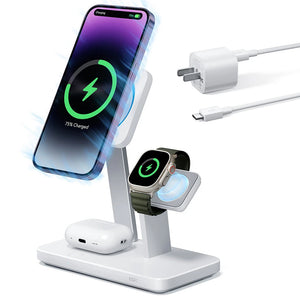
Charging is the other half of that equation. A larger battery paired with faster charging speeds — which the rumors also point to — makes a wireless charging setup worth having around rather than optional. Our current wired charger and wireless charger lineup covers most of the ways people actually charge a phone day to day: a desk stand for the office, a compact charging pad for a nightstand, and a foldable 3-in-1 travel charger for anyone who'd rather carry one charger for their phone, watch, and earbuds instead of three separate cables. These are built around MagSafe and Qi2 standards that already cover iPhone 12 and later, including the iPhone 18 once it ships — so it's not a purchase you'd be making twice.
FAQ
Is the iPhone 18 Pro getting a big battery upgrade?
Not really. The leaked numbers suggest less than a 2% increase over the iPhone 17 Pro. The Pro Max is expected to see the larger gain, around 6–8% depending on the SIM configuration, with reports indicating a battery exceeding 5,000mAh across all storage options. So, claims that the entire iPhone 18 Pro lineup is getting a major battery upgrade only apply to the Pro Max.
What's the difference between eSIM and physical SIM battery capacity?
Physical SIM models require space for a SIM tray, while eSIM-only models can use that space for a slightly larger battery. As a result, eSIM versions of the same iPhone often have marginally higher battery capacity. This difference also appears in the leaked battery specifications for both the iPhone 17 and iPhone 18 series.
Does the iPhone 18 have a removable battery?
No. Current leaks point to a redesigned metal battery enclosure for improved heat management, but there is no indication that Apple plans to introduce a user-removable battery with the iPhone 18 series.
When will we know if these leaks are accurate?
Apple is expected to officially announce the iPhone 18 lineup in September. Until then, all battery specifications remain unofficial. We'll update this article with confirmed information once Apple reveals the final details.


